EDUCATION ARCHIVE
TEN IMPORTANT ECONOMIC INDICATORS EXPLAINED
Investors are hearing that the economy is beginning to recover. Here are the leading indicators to watch that will give you a pulse on the U.S. economy.
1) Real GDP (Gross Domestic Product)
What is it?
The real GDP is the market value of all goods and services produced in a nation during a specific time period. Real GDP measures a society's wealth by indicating how fast profits may grow and the expected return on capital. It is labeled "real" because each year's data is adjusted to account for changes in year-to-year prices. The real GDP is a comprehensive way to gauge the health and well-being of an economy.
Why is it important?
The Federal Reserve uses data such as the real GDP and other related economic indicators to adjust its monetary policy.
Where does the data come from?
The U.S. Department of Commerce?s Bureau of Economic Analysis releases the data quarterly, including any revisions, within the last week to 10 days of each month following the end of the quarter. Data are spelled out as being "advance estimates," "preliminary estimates," and "final" numbers. Each data release includes an explanation of why the GDP increased or decreased from the previous quarter (quarterly data are also annualized).
2) M2 (Money Supply)
What is it?
M2 money supply represents the aggregate total of all money a country has in circulation. It takes into account all physical currency such as bills and coins; demand deposit savings and checking accounts; traveler's checks; assets in retail money market accounts and small money market mutual funds, (i.e., less than $100,000); individual time deposits and savings deposits, such as certificates of deposits; in addition to some repurchase agreements and Eurodollar holdings.
It does not include institutional money fund assets, large denominated (more than $100,000) time deposits, or any special reserves banks are required to maintain.
Why is it important?
The Federal Reserve uses this data to assess current economic and financial conditions, and to help alter its monetary policy, which includes raising and lowering interest rates. The Fed's actions are aimed at bolstering or reducing the money supply.
Economists and others also use M2 data to predict cyclical economic recessions and recoveries and expected changes in stock prices?not to mention expected changes in the Fed's monetary policy.
Some economists believe that M2's relevancy has waned over the past 20 years. For many years this monetary measurement had closely paralleled the growth or contraction of the U.S. economy and overall changes in prices. But over the past two decades, a bevy of changes-such as the introduction of new depository products, the movement of consumer funds from bank deposits to investment accounts and the internationalization of the economy-has caused the money supply data to fall out of sync with other economic indicators.
Nevertheless, the Fed and some economists and analysts pay attention to the longer-term trends in growth or reduction of the money supply, particularly the six-month figures. And the Fed retains its power to increase the money supply by lowering interest rates as a way to counter a sluggish economy, and to reduce the money supply by raising interest rates if the economy gets overheated.
Where does the data come from?
The Board of Governors of the Federal Reserve System releases the data both weekly (on Thursdays) and monthly, during either the second or third week of the month. Monthly data goes back to January 1959; weekly information has been available since January 1975.
3) Consumer Price Index (CPI)
What is it?
The CPI measures changes in the prices paid for goods and services by urban consumers for the specified month. The CPI is essentially a measure of individuals' cost of living changes and provides a gauge of the inflation rate related to purchasing those goods and services.
The CPI does not include every item an individual may buy, but instead takes a sampling of several hundred goods and services across 200 item categories. Data is collected through phone calls and personal visits in 87 urban areas across the country.
The CPI does not include income, Social Security taxes, or investments in stocks, bonds or life insurance. But it does include all sales taxes associated with the purchases of those goods and services.
Why is it important?
This statistic is the best indicator of inflation that we have to rely on. It is particularly closely scrutinized by financial economists now since it shows inflation to be at a 16-year low. Changes in inflation can spur the Fed to take action to change its monetary policy.
Where does the data come from?
The U.S. Department of Labor?s Bureau of Labor Statistics releases the national CPI-an average of all areas sampled, monthly, during the second or third week after the end of the measured month. CPIs for three specific metropolitan areas are also published monthly, while CPIs for other specific metropolitan regions are published every other month. Data releases include details about very specific products.
4) Producer Price Index (PPI)
What is it?
The PPI is a group of indexes that measures the changes in the selling price of goods and services received by U.S. producers over a period of time. Think of it as the business-side equivalent to the CPI that measures changes in prices paid by consumers: The PPI captures price movements at the wholesale level, before price changes have bubbled up to the retail level.
The PPI tracks price changes in virtually all goods-producing sectors, including agriculture, forestry, fisheries, mining and manufacturing. The PPI also tracks price changes for a growing portion of the non-goods-producing sectors of the economy as new PPIs are introduced. Prices from 25,000 establishments are tracked monthly.
This report measures prices for goods at three stages of production: finished goods, intermediate goods and crude goods.
This was called the Wholesale Price Index from 1902 until 1978.
Why is it important?
This index is timely because it is the first inflation measure available in the month. In addition, by watching crude prices, which are first in the chain of production trends, one can sometimes spot inflation in the pipeline, before it shows up in the CPI.
Where does the data come from?
The U.S. Department of Labor'?s Bureau of Labor Statistics releases the data monthly, during the second full week of the month following the reporting month.
5) Consumer Confidence Survey
What is it?
A gauge of the public's confidence about the health of the U.S. economy that reflects the public's optimism/pessimism and the nation?s mood.
Five questions are asked of a random sampling of 5,000 individuals, of whom about 3,500 respond. The survey asks their thoughts and feelings about business conditions, the labor market, consumer spending and economic growth, and their financial and employment expectations six months into the future. Each question can be assigned three opinions: positive, negative and neutral.
Why is it important?
This statistic is a leading indicator of consumer spending-consumers are more inclined to spend money when they are feeling confident about their financial and employment prospects.
Where does the data come from?
The Conference Board's Consumer Research Center releases the data monthly on the last Tuesday of each month.
6) Current Employment Statistics (CES)
What is it?
CES provides comprehensive data on national employment, unemployment and wages and earnings data across all non-agriculture industries, including all civilian government workers. Information is disseminated in many different ways-for example, employment/unemployment rates among men and women, varied ethnic groups and teens.
Employment data is based on a survey of 300,000 establishments across 600 industries, which account for approximately one-third of all payroll employees. Industries include retail trade, manufacturing and construction. CES provides details on numbers of hours worked and earnings of all surveyed across the nation.
The "employed" are defined as all full- and part-time workers and temporary and intermittent employees who received pay for the cited period. It includes those on paid vacation or sick leave, and excludes business proprietors, self-employed, unpaid family members and volunteers.
Why is it important?
This is the earliest indicator of economic trends released each month. Employment rates indicate the well-being of the economy and labor force. Changes in wages point to earnings trends and related labor costs. Economists focus on the monthly change in total non-farm payrolls and in which sectors jobs were gained or lost.
Interesting trends can also be derived from the payroll data, such as the average number of hours per week worked and the average hourly earnings. This data gives an indication of how tight the labor market is-tight labor markets can translate into wage inflation.
Where does the data come from?
The U.S. Department of Labor's Bureau of Labor Statistics releases the data monthly, usually on the first Friday following the reference month, but always within the first 10 days after month-end.
7) Retail Trade Sales and Food Services Sales
What is it?
This data tracks monthly U.S. retail and food service sales, details changes from previous periods, and identifies in which sectors sales increased and/or decreased.
The data is based on a random sampling of 5,000 retail and food service firms. Figures are broken out to both include and exclude sales of automobiles. Sales are weighted and benchmarked to represent the nation's three million retail and food services firms.
Why is it important?
The numbers measure consumers' personal consumption across retail industries and track growth or deceleration of personal consumption spending, which makes up approximately two-thirds of the annual U.S. GDP. Analysts use the data to help track consumer spending trends and forecast the direction and magnitude of future spending. Automobile sales are separated from the data because of their volatility, which can sometimes obscure the underlying pattern of spending.
Where does it come from?
The U.S. Department of Commerce's U.S. Census Bureau releases the data monthly, during the second week of each month.
8) Housing Starts (Formally Known as "New Residential Construction")
What is it?
An approximation of the number of housing units on which some construction was performed during the month. Data is provided for single-family homes and multiple unit buildings. The data indicates how many homes were issued building permits, how many housing construction projects were initiated and how many home construction projects were completed.
Why is it important?
Housing starts are highly sensitive to changes in mortgage rates, which are affected by changes in interest rates. Although this indicator is highly volatile, it represents about 4% of annual GDP, and can signal changes in the economy and the effects of current financial conditions. Analysts and economists know to watch for longer-term trends in housing starts.
Where does the data come from?
The U.S. Department of Commerce's U.S. Census Bureau releases the data monthly, within two to three weeks after the end of the reporting month.
9) Manufacturing and Trade Inventories and Sales
What is it?
This data represents the combined value of trade sales and shipments by manufacturers in a specific month, as well as the combined values of inventories in the wholesale and retail business sectors and manufacturing. The current and most recent past month's inventory/sales ratios are also provided. Information is provided across 17,000 manufacturing, retail and wholesale companies within 160 industries.
Why is it important?
This data set is the primary source of information on the state of business inventories and business sales. Inventory rates often provide clues about the growth or contraction of the economy. A growth in business inventories may mean sales are slow and the economy's rate of growth is also slowing. If sales are slowing, businesses may be forced to cut production of goods, and that can eventually translate into inventory reductions.
Where does the data come from?
The U.S. Department of Commerce's U.S. Census Bureau releases the data monthly, approximately six weeks after the end of the subject month.
10) S&P 500 Stock Index (the S&P 500)
What is it?
The Standard & Poor's 500 is a market-value-weighted index of 500 publicly owned stocks that are combined into one equity basket. This basket of stocks has become the industry standard and benchmark for the overall performance of the U.S. equity markets.
The S&P Index Committee chooses the indexed stocks based upon market size, liquidity and industry group representation. Component companies are periodically replaced. Companies are most often removed because of a merger with another company, financial operating failure or restructuring. Prospective companies are placed in an index "replacement pool" and vacancies are filled from that pool.
Why is it important?
The index is designed to measure changes in the stock prices of component companies. It is used as a measure of the nation's stock of capital, as well as a gauge of future business and consumer confidence levels. Growth of the S&P 500 index can translate into growth of business investment. It can also be a clue to higher future consumer spending. A declining S&P 500 index can signal a tightening of belts for both businesses and consumers.
Economists tend to look for long-term trends rather than short-term fluctuations in the S&P 500 index. The S&P 500's 10-year total return, for example, has become a common indicator of longer-term trends.
Where does the data come from?
Standard & Poor's is solely responsible for compilation of the S&P 500 index. However, real-time information on the index is available daily from financial news organizations and publications, as well as from Standard & Poor's.
What are stocks, bonds, and cash?
The broadest categories of financial investments are:
- Stocks: An ownership interest in a corporation that is represented by shares.
- Bonds: A bond represents a debt, or an IOU, from an issuing entity to a bondholder.
- Cash: Paper currency, coins or short-term money market investments.
|
Nominal and Real Average Returns for Seven Different Asset Classes, 1975
|
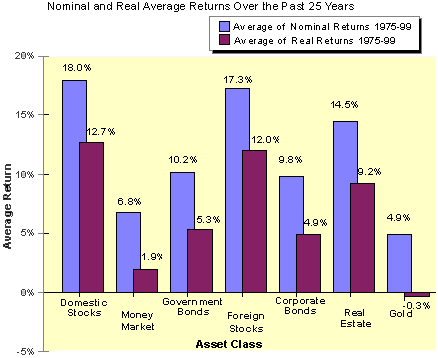
Real Average Return - generally reflect returns without inflation factors
Nominal Average Returns - reflects actual reported returns |
|
This chart compares the average of nominal returns and the average of real returns on domestic stocks, money markets, government bonds, foreign stocks, corporate bonds, real estate, and gold for the period from December 31, 1974, to December 31, 1999. Source: ChartSource, Standard & Poor's Published Image. Domestic stocks are represented by the total annual returns of Standard & Poor's Composite Index of 500 Stocks, an unmanaged index that is generally considered representative of the U.S. stock market. Foreign stocks are represented by the total annual returns of the Morgan Stanley Capital International Europe, Australasia, Far East (EAFE®) Index, an unmanaged index that is generally considered representative of developed foreign markets. Long-term government bonds are represented by the total annual returns of long-term Treasuries (10+ years) and constructed from yields published by the Federal Reserve. Money markets are represented by the yield of 90-day Treasury bills as published by the Federal Reserve. Long-term corporate bonds are represented by the total annual returns of long-term Baa-rated corporates and constructed from yields published by Moody's. Inflation is represented by the annual change in the Consumer Price Index. Gold performance is represented by the change in the cash price of gold. Real estate investment trusts (REITs) are represented by the returns of the NAREIT Index of all publicly traded REITs. Past performance is no guarantee of future results. A direct investment in an index is not available. |
|
|
Domestic Stocks
|
Money Market
|
Government Bonds
|
Foreign Stocks
|
Corporate Bonds
|
Real Estate
|
Gold
|
| Average of Nominal Returns 1975-99 |
18.0% |
6.8% |
10.2% |
17.3% |
9.8% |
14.5% |
4.9% |
| Average of Real Returns 1975-99 |
12.7% |
1.9% |
5.3% |
12.0% |
4.9% |
9.2% |
-0.3% |
|
|
| Expectations. The chart at right shows how you might expect a dollar invested in cash, bonds, or stocks to grow over 25 years, based on historical returns. These numbers exclude inflation to show the growth in real purchasing power. The average return for each class of investment is represented by the line between the red and green areas.
Clearly, stocks won. So why not invest all of your money in stocks? First, past performance cannot guarantee future results. Second, you may not be investing for 25 years. Generally, the shorter the time until you will need to spend your money, the more conservative you should be so that you aren't hurt by a temporary down swing in stock values. Third, stocks are the most risky -- note the extremely wide range possible with stocks. Financial catastrophes have happened in the past, and will happen in the future -- we just don't know when.
In the Great Depression, stocks lost about 90% of their value from the peak in 1929 to the bottom in 1932. But the value of many bonds, particularly government bonds, actually went up during the same period. |
The Importance Of Starting Early:
Time, your contribution level, and the rate of return your account earns are really the only three ingredients in a well thought out retirement plan. Time is a key element because you need to decide:
- When to retire
- When to begin saving in earnest
Compounding is also one of the reasons you should start saving as early as possible.
|
The Effect of Starting to Invest Early vs. Waiting
|
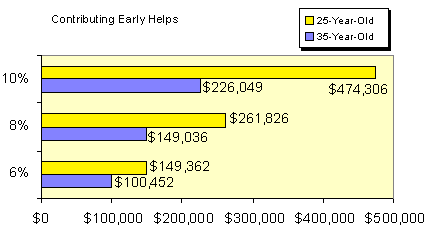
| *These examples are intended to illustrate tax deferral and make no intimations about performance. Illustrations assume interest rate of 6%, 8%, and 10%. |
|
|
Investing a smaller dollar amount over a longer time horizon can have a greater impact on investment results than investing a higher dollar amount for a shorter period of time. This chart shows the dollar values at age 65 for a 25-year-old investing $75 a month and a 35-year-old investing $100 a month. By beginning to invest earlier, the 25-year-old was able to invest less each period and achieve a higher account balance at age 65. |
| |
35-Year-Old |
25-Year-Old |
| 6% |
$100,452 |
$149,362 |
| 8% |
$149,036 |
$261,826 |
| 10% |
$226,049 |
$474,306 |
|
Compound interest is a powerful force. Albert Einstein reportedly called it the "eighth wonder of the world." The magic in compounding is that year by year, you earn interest on the money you've contributed (your principal) and on top of that, your interest earns interest. The bottom line is, if you start early, you may not have to save as much to pursue your goal. In other words, giving up a big-screen TV today could mean you may not have to give up a vacation home.
The Tax Benefits of Retirement Planning
The 401(k) offers you the chance to benefit your tax situation in two ways - by reducing your tax burden now and allowing your account to grow tax-deferred.
First, if you choose to make pre-tax contributions, you help lower the amount of your income that is subject to income tax. Therefore, you pay lower taxes now.
The money you contribute to your 401(k) is subtracted from your pay before federal taxes are withheld. If you're in the 28% tax bracket, the choice is between contributing $100 to the plan and taking home less than $72 in your pocket.
Second, the benefits of tax-deferred growth can go on and on. And tax-deferred growth is available in both your 401(k) Plan. Compare an investment in taxable and tax-deferred scenarios.
The chart shows the results of investing $500 per year for 30 years until you retire. The assumption is that you earn 8% annually (compounded monthly) on your savings until retirement and you are in the 28% tax bracket. Even though you have to pay tax on the deferred savings and accumulated earnings as you withdraw them, the potential effect of tax-deferred compounding is so powerful that it may outweigh the taxes you pay later.
This example is hypothetical. Investment returns will fluctuate and cannot be guaranteed.
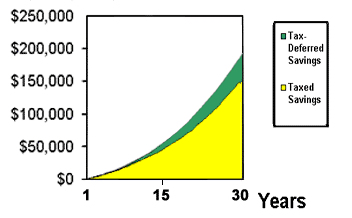
These examples are intended to illustrate tax deferral and make no intimations about performance. Illustrations assume:
This illustration does not illustrate any actual product and that fees and charges associated with an actual product would have the impact of lowering values.
* Please note that withdrawals prior to age 59 1/2 may result in an additional 10% tax penalty. |
|
What Is Inflation?
Inflation is a general trend of increasing prices. You might be surprised to hear there is also such a thing as deflation, or generally decreasing prices, because we haven't seen that phenomenon in the United States in more than 50 years. As measured by the Consumer Price Index, prices are now 15 times what they were before World War I, and four times what they were in 1970. In the past century, there have been years when prices rose substantially, but also years when they fell (deflation).
What Causes Inflation?
When demand for goods or services exceeds the supply, the providers of these goods and services tend to raise their prices. This is called "demand-pull inflation." When a company passes increased production costs along to its customers, this is cost-push inflation. Higher prices trigger all sorts of other inflationary behavior, such as workers everywhere demanding higher salaries, which causes producers to raise their prices again, and so on.
How Is Inflation Measured?
The most widely recognized measure of inflation in the United States is the Consumer Price Index (CPI), which is produced by the U.S. Bureau of Labor Statistics. Each month, Bureau of Labor Statistics field staff visit or call thousands of retail stores, service establishments, rental units, and medical offices all over the United States to obtain price information on the items in the CPI "market basket." The goods and services (about 90,000 of them) included in the market basket are all considered representative of the purchases of urban consumers and wage earners.
Although the CPI is often quoted in the news and is a key piece of data for national economic policy making, it almost certainly doesn't reflect your personal experience as a consumer.
Understanding Diversification, or: "Don't Put All Of Your Eggs In One Basket"
That old saying may be time worn, but it's true. It illustrates one of the most fundamental rules of sound investing: Diversification. Professional portfolio managers live by it. It also explains why mutual funds have become a practical choice for many investors.
Diversification, in fact, can be a key to successful investment of your retirement account. By dividing your savings among a number of different options with different behavior patterns, you can help them. You may also lessen your chances of missing out on a home run.
|
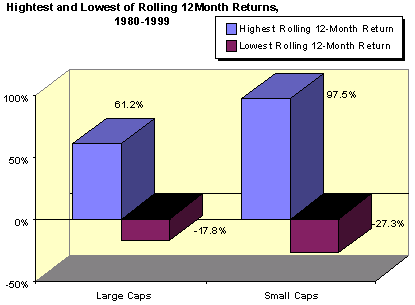
Highest and Lowest Returns for Large-Cap and Small-Cap Stocks, 1980 to 1999
|
 |
|
| Large- and small-cap stocks have different risk/return characteristics. As the chart above shows, for the period from December 31, 1979, to December 31, 1999, small-cap stocks experienced wider swings than their large-cap counterparts. Source: ChartSource, Standard & Poor's Published Image. Small-cap stocks are represented by the total returns of the Russell 2000 Index. Large-cap stocks are represented by the total returns of Standard & Poor's Composite Index of 500 Stocks. Keep in mind that individuals cannot invest directly in any index, the performance of any index is not indicative of the performance of any particular investment, and results do not take into account the fees and expenses associated with purchasing mutual fund shares or individual securities. Past performance is no guarantee of future results. |
| |
Large Caps |
Small Caps |
| Highest Rolling 12-Month Return |
61.2% |
97.5% |
| Lowest Rolling 12-Month Return |
-17.8% |
-27.3% |
How Much Risk Is Right?
Risk-taking in the financial sense is completely distinct from risk-taking in daily life, even though much of the language surrounding investment practices is similar. The most mild-mannered people can be extremely aggressive investors. Liberal voters can be conservative investors.
Many people believe they have a low tolerance for financial risk because they don't go bungee jumping or whitewater rafting. However, if you feel that you can handle some ups and downs in the market without losing too much sleep, then you may be ready to do some aggressive investing. You'll need to consider the length of time you can let the money sit and your resources.
What Do Economists Mean by Risk?
In the world of investments, risk generally refers to the chance that your assets will decrease in value for some period of time. There are two main ways this can happen:
- A decline in value due to a drop in the value of your investment, and
- A loss of purchasing power due to inflation.
Why Take Risks At All?
For one thing, you can't avoid them. Bonds and money market accounts are considered conservative investments because they strive to avoid risk of loss to principal, but they are still subject to inflation risk. Investments in stocks, on the other hand, involve risk of loss and are considered "aggressive." The greater the risk of loss, the more aggressive the investment.
Some risk of principal may be worth taking to try to win the battle against inflation. An important key to managing your risk is diversification - putting your money into several different kinds of investments so that a loss in any one of them may be offset by potential gains.
Do Risk Levels Change Over Time?
Absolutely. If you are close to retirement age now, it does not make sense to invest too heavily in stocks because over the short term, there's greater risk of experiencing a substantial loss. But if you have many years to go before you will need to draw on your 401(k) or profit sharing account, then time may be on your side. For instance, there has not been one 25-year period since 1906 when stocks have not increased in value. Even investors who were in the market through the Depression in the 30s still came out ahead if they stayed in for 25 years. Past performance, however, cannot guarantee future results. (SOURCE: STANDARD & POORS)
See more on risk in Analyzing Investment Products and Services section.
What is a 401(k)?
The name 401(k) comes from a section of the Internal Revenue Code, which was originally added in 1978 to regulate cash-deferred bonus programs. No one foresaw that more than 20 million working Americans today would have more than $500 billion in retirement savings invested in their employers' 401(k) plans.
401(k)s are employee benefits. But they are not like vacation days or health coverage, which come with the job automatically. As a Company employee, you must decide for yourself whether you want to invest in the plan. In general, the 401(k) is an excellent investment opportunity because you pay no tax on any of the money in your account until you withdraw it during retirement.* The Company also provides a matching contribution which is also tax-deferred. The combination of no taxes and extra money helps get your investment off to a great start. However, it's your responsibility to decide how much to contribute and how to invest your 401(k) contributions in the funds available. In other words, there are no guaranteed returns on your investment.
*Early withdrawals are subject to a penalty tax.
Why Join a 401(k) Plan?
So, you're not sure you want to join your company 401(k) plan. You're worried you can't afford it. Or maybe you think you're too young to be planning for retirement. Think again. You're lucky to have a 401(k) plan available to you. It's a benefit that many people don't have.
Why should you join your 401(k) plan? Let's address your concerns:
I Can't Afford to Join the Plan.
If you're thinking that you can't afford to join the plan because it will cut into your take-home pay, consider this: You'll probably keep more money than you think. Because most contributions to 401(k) plans are made with pre-tax dollars, they reduce your taxable income, and therefore the amount of taxes you pay now.
In other words, the reduction in take-home pay that results from your plan contribution is partially offset by a drop in your income tax.
The money you contribute to your 401(k) is subtracted from your pay before federal taxes are withheld. For example, if you're in the 28% tax bracket, contributing $100 to the plan, allows you to defer the $28 you would have paid in taxes.
I'm Too Young to Think About Retirement
The younger you are, the more time you have on your side. Starting early can make a big difference. If you contribute just $5.77 a week for 20 years, you will have saved close to $20,000 toward your retirement (based on an annual return of 6% on your investments). This is the power of compound interest. *
This example doesn't even take into account the possibility that your company may provide you with additional money, or what is called a "matching contribution." Matching contributions are, in essence, instant returns on your money.
In the end, you can't afford not to join. If you're like most people, about 25% of your retirement income will have to come from money you've set aside. And with the ease of saving through a 401(k) plan (i.e., automatic payroll deductions), this 25% could largely be made up of 401(k) money.
What follows is a series of screens that will show you how well you are pursuing your retirement income goals and how your 401(k) plan can help fill any gaps.
* This example is hypothetical. Investments returns will fluctuate and cannot be guaranteed.
What Is Life Expectancy?
The biggest mystery of retirement planning is how long your money will need to last. This is a good news/bad news situation. The good news is that people are living longer - you may live 30 years or longer in retirement. That can also be a problem, because it means your retirement income will need to last a long time. Life expectancy tables try to predict how long people will live.
You want to be sure you don't run out of money. So, although we estimate a life expectancy figure for your planning purposes, we strongly encourage you to set up a plan that will provide you with income for much more than the median life expectancy.
How Accurate Are Life Expectancy Tables?
Life expectancy tables are accurate, if you're interested in the median number of years that a population lives starting from a given age.
But life expectancy tables aren't so accurate if you're planning for your own life. For one thing, a median is not an average. It is simply whatever number falls smack in the middle of a numerically ordered group. So if you kept track of a group of 101 people and wrote down their ages when they died in numerical order, the 51st number on your list is the median.
Then there are the undeniable factors of heredity, lifestyle, and environment, which you must consider for yourself.
The most valuable message to take away from life expectancy tables is that none of us should be surprised to live to a ripe old age. The number of people aged 100 or over has doubled every ten years since 1950.
Social Security
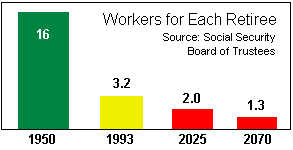
Social Security was never intended to provide complete coverage of the living expenses for retirees. It was intended to be a supplement.
The benefits paid by Social Security to retirees come from workers and employers in the form of Social Security taxes. As this chart shows, the number of workers who are contributing to Social Security has dropped over the past decades, and will continue to decline in the future. This calls into question whether Social Security will be able to continue paying the same level of benefits as it currently does. The uncertain future of Social Security makes it even more important that you save enough to provide your own retirement income.
UNDERSTANDING THE IMPORTANCE OF COMPOUNDING
Managers and investors generally consider growth to be an absolute good. Managers routinely discuss stretch objectives and sometimes even embrace ?big, hairy audacious? goals to motivate their employees and to impress their shareholders. Growth investors routinely seek companies that promise rapid, sustainable increases in sales and earnings.
But most investors do not intuitively understand the power, and onus, of compounding. To see how you stack up, take this little quiz:
One dollar today ($1) becomes how much when compounded over 20 years? Write the amount in the space provided.
|
Starting amount:
|
Compounded at:
|
Becomes how much after 20 years?
|
|
$1
|
2%
|
________
|
|
$1
|
7%
|
________
|
|
$1
|
15%
|
________
|
|
$1
|
20%
|
________
|
For most of us, these calculations do not come naturally. A 2% compounded annual growth rate (CAGR) over 20 years turns $1 into $1.49. A 7% growth rate equals $3.87. A 15% rate—a common earnings growth goal among large companies—implies a value of $16.37. And finally, $1 compounded at a 20% rate becomes $38.34.
How did you do? If you are like most people, you had difficulty properly gauging the relationship between the growth rate and the ending value. For example, it is not intuitive to most investors that an increase from 15% to 20% growth implies more than a value double after 20 years. That?s why Albert Einstein called compounding the ?eighth wonder of the world.? The trick for investors is to make the compounding work for them, not against them.
FAQ Analyzing Investment Products Mutual Funds Retirement U.S. Savings Bonds Variable Annuities Brokers and Advisors Just for Women Basic Investment Terms Let Us Know Home