Under the Microscope: Focus on Lifestyle or Target-Date Funds -June 11, 2008
Financial Follies: Bank Deposit Rates VS. Money Market Funds -May 2008
Auction Rate Securities -April 2008
Preventing Identity Theft NEW ARTICLE
Biggest Investment Scams According to State Securities RegulatorsNASDAQ Bulletin Board and Pink Sheet Stocks
Protecting Yourself From The Most Common Scams
Target-date funds are mutual funds that claim to be customized to
your target retirement year. As retirement nears, say
2020, the fund holdings become more conservative and invest more in
bonds than stocks. The concept is simple and given
their long term investment horizon makes sense for retirement plans.
Unfortunately, there is a vast difference among
these types of funds that really have yet to face the scrutiny that is
needed to differentiate among fund families.
Target-date funds are meant to offer convenience, and be a “one stop
shop” for investors planning for retirement.
Sometimes these funds chase performance and may not be in the best
interests of the investor. With a little research,
the investor could pick mutual funds themselves that would be customized
to their specific situation, and their risk
level. These funds have become the default choice in many retirement
plans, replacing the typical money market default
option. These target date funds offer an appealing convenience factor in
the confusing world of retirement investing,
but we encourage the investor to be proactive and choose funds that are
in their best interests, not in the interests of
money manager firms looking to take advantage of ill-informed investors
simply looking for convenience. After all, the
average investor, or even 401K Trustees, is unaware of the new layers of
fees inherent on all of these types of funds.
As more and more retirement plan sponsors use target-date funds as their
default options, it is more important than ever
to differentiate fund choices and make sure they select the fund family
that best fits their objectives and risk
profile.
Auction-Rate Securities - April 2008
Similar to late 1999 when we warned about the
excesses in the technology arena with the dot-com mania, in May of 2007
we felt that many areas of the U.S. and emerging markets were
over-extended. One of our publications which was printed in early
November 1999 proved early as the NASDAQ continued to surge for several
months thereafter, but investors who did not take money away from the
technology/telecom sectors at the start of this decade were saddled with
huge losses the next 2-3 years. Some favorite areas of investors last
May were once again beginning to get significantly overvalued, resulting
in much higher risk for investors than what was typical at the time.
At the time, staid low growth sectors like the utilities were tracking
the remarkable performance of the Shanghai stock
market for the prior three years. During times like these, the proactive
investor must realize the importance of taking
profits and lessening exposure (risk) in those popular, overpriced
areas. After hearing from so many investors who were burned with
overexposure in tech stocks in 2000-2002, we felt compelled to let even
more investors know about our latest words of warning early last summer
when the global markets were still hitting daily new highs. In June of
2007 we made several national media appearances in order to discuss,
among other items, the importance of profit taking, especially in
overvalued “hot” areas of the market, and that the ripple effects of
sub-prime will be much more pervasive than investors believe - both in
terms of the financial sector, as well as in affecting the U.S. and
global economies.
Just like in 1999 with technology, there were areas where we could have
done even more to protect our client’s assets. We will always strive to
do better and not rest on our laurels. We are confident that more
investors heard our warnings in June 2007 and our emerging market
(particularly China and India) and tech stock warnings in the 4th
quarter of 2007, when all these areas were erroneously hyped by other
experts as ways to avoid the sub-prime mess.
Now as investors are becoming increasingly despondent and worried about
the global markets, we are beginning to find select bargains. It is
comforting to be in a solid cash position into this volatile market,
giving us the luxury to buy
into panic selling at significantly lower prices. Beyond taking profits
at all time highs from many exposed sectors last summer, the cash we
built up also was an important factor in protecting assets over the past
six months as most global markets declined sharply. We are gradually
buying into this weakness, re-deploying some of the profits we took
earlier. Just like in May of 2007, we still do not expect to see global
markets establish new highs anytime soon. The only difference is that
now values are becoming more attractive, but there are still too many
uncertainties to be fully invested or totally exposed to the
global markets.
A prudent strategy to take advantage of emotional selling and
selectively adding assets to control risk, still is in
order. The madness of March may have brought an end to a majority of the
financial sectors plunge, but getting the
sector back to a long term uptrend will most likely take more time.
Again, similar to the over excesses in tech with
dot-com, the financials and real estate areas must pay for many years of
excesses and this will take time. Even if the
worst is over for most financials, the U.S. economy will still have to
face difficult headwinds. Inflation is raising
its ugly head, especially in some of the fast growing emerging markets,
and investors are finally realizing that the
global markets are not decoupled from the U.S., so China may face a very
difficult period of stagflation (we brought
this possibility up to investors six months ago) and that is never good
for financial assets. When investors add the
uncertainty of the U.S. Presidential election, growing geo-political
risks, and financial markets that are just
awakening to all the ripple effects of the credit crisis, you have a
challenging market that warranted a solid cash
position.
We are still seeing new clients coming in that are taking much more risk
and are overexposed in emerging markets and financials - similar to what
we had seen in 2001-2002 in technology. This leads us to believe that it
will still take
more time to wash out all the global excesses of the past seven years.
Most of these investors are in a position where
not only do they not understand the risk they are taking, but are just
beginning to realize that they should never have
been investing in those high risk areas in the first place.
Most investors are in for more negative surprises into early 2008. Some
examples we see include conservative investors who are in asset
allocation programs with significant exposure in emerging markets
without fully understanding the consequences. Other investors are
discovering that their auction-rate securities that were sold to them
(Merrill Lynch, UBS, Morgan Stanley were the top three sellers) by many
brokers as a conservative, safe and liquid money market type substitute
are now frozen as the window to redeem these auction rate securities is
closed. Our managed accounts avoided such structured vehicles that were
great in adding fees/commissions (just like the various structured
mortgage type products, hedge funds, SMA’s, etc.) to the brokerage
coffers, but did little to help the investor.
Whether we continue to avoid these traps for investors is impossible to
determine, but we will continue to do our best
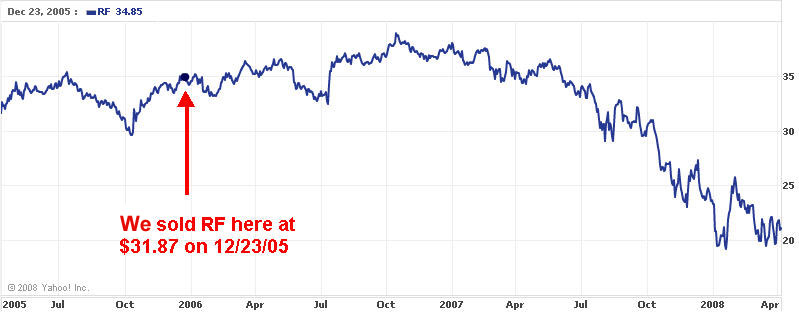
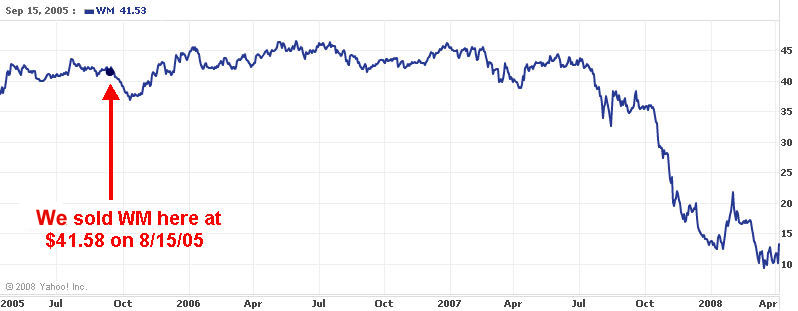
to avoid these costly pitfalls. The graphs below show when we took
full profits in two financial holdings for our
managed accounts. Our sell recommendation occurred 12-18 months before
these stocks, and the financial sector,
collapsed. This illustrates the importance of a long term perspective
(we were also early in taking profits in the
technology sector in 1999) as investors must look at the complete
picture by observing what happened to these popular and overvalued areas
over the subsequent 2-3 years.
Performance of Financials and
REITs through 3/31/08
|
Index |
6/1/07 Price |
3/31/08 Price |
% Change |
|
Dow Jones U.S. Financials Index |
608.77 |
410.06 |
-32.6% |
|
Dow Jones Equity All REIT Index |
323.13 |
256.31 |
-20.6% |
Biggest Investment Scams According to State Securities Regulators
Over the past five years soundinvesting.org has been warning investors regarding the dirty little games many brokerage firms and mutual fund organizations play in terms of marketing and compensation. Massachusetts securities regulators recently filed a civil administration complaint against Morgan Stanley alleging that the brokerage firm provided incentives to its brokers to sell in-house mutual funds over those run by outside managers while not disclosing those added incentives to investors. Among the incentives mentioned in the complaint include Morgan Stanley's entire compensation system which favors in house mutual funds for both brokers and their managers. Some outside funds also paid money to Morgan Stanley for access to brokers in attempts to get them to push their funds. The complaint highlighted a three month sales contest held in 2002 expressly to boost sales of Morgan Stanley Funds and funds run by Van Kampen Investments, which is owned by Morgan Stanley. Sales of these funds are more profitable to Morgan Stanley than sales of funds run by outside companies. Yet none of those incentives had been disclosed to clients. These charges are separate from a complaint filed in July 2003 in which Massachusetts accused Morgan Stanley of misleading investigators about the existence of these types of incentive programs. Unfortunately, such games are being played by mutual fund organizations and brokerage firms without investor knowledge. The N.A.S.D. is proposing a potential new industry rule that would require firms to disclose in writing the nature of certain compensation arrangements as soon as a customer opens an account or purchases mutual fund shares. Soundinvesting.org has always stressed to get all costs, risk and compensation disclosed in writing, from whomever you are working with, before making any investment. Such transparency is needed in the $6.5 trillion mutual fund industry and we do not recommend working with anyone that does not fully disclose such information to you. Mutual funds are not the only ones laden with such undisclosed conflicts as similar potential problems are seen when buying individual stocks or bonds. For example, stockbrokers may receive added compensation to push certain equities, including stocks held by broker/dealers that it wants to move out of inventory (principal trades). In contrast, investment advisors must clearly disclose the conflicts in principal trades and must secure permission in advance from clients. Mandatory disclosure is needed but for the moment investors must still ask for it in writing. -August 2003
After a three year decline in many stock prices we are getting e-mails that state some investors are simply not opening their brokerage, mutual fund, or retirement plan statements. One individual even stated their broker told them to not look at their statements if they are too painful. This procedure could lead to other problems beyond poor investment performance and we strongly recommend verifying all activity in each and every statement promptly upon receipt.
Here are some of the specific items we would check with each statement:
If you do not check your statements an unscrupulous broker/banker has you exactly where he/she wants you. This is because without proper notification you lose rights to correct an error, in many instances within 60 days after the improper occurrence. In other instances lack of notice will result in delays and potentially higher costs in your efforts to get things straightened out. Immediately question any transaction or entry that you do not understand or that you did not authorize. There are three steps to take if you find errors. First talk to your broker/dealer and get an explanation with follow up written confirmation that this will be corrected. Then make sure on your next monthly statement the adjustment(s) have been reflected. If you can't resolve the problem with your broker/banker, or if you think he/she is involved in misconduct (i.e. unauthorized trades), then report it to the firm's management or compliance department in writing. Declare a date in your letter (usually 30-60 days) to get this resolved and after that time frame file a complaint with the NASD online complaint form.
Two other questionable tactics that desperate brokers/bankers have been using include:
The huge financial success of the 1990’s has spurned on an unprecedented array of new scams and frauds aimed at the average investor. Historians will look at the 1990’s as the golden age of success for investors as well as the advent of dramatically higher level of financial fraud. It was a decade that a Canadian gold mining company called Bre-X Minerals Ltd. saw its stock soar to $4.5 Billion, until its much hyped Indonesian mine was exposed as a hoax. Fraudulent trading brought down two eminent investment banking firms in succession Kidder Peabody & Co. and Baring Bros.
The 1990’s finished with would be insurance mogul Martin Frankel and energetic market guru Martin Armstrong being arrested within days of each other, each charged by federal prosecutors for swindling investors out of hundreds of millions of dollars. In addition, a San Antonio group called InverWorld, Inc. was accused by the Securities & Exchange Commission of defrauding Mexican clients of the bulk of their $475M in investments.
While these scandals have received the majority of the headlines, regulators say the most devastating fraud for the average investor is the long running epidemic of small stock scams. They feature pushy telephone salesmen stealing billions from naive investors each year. Advancements in technology, including ease of access via the internet, has made scams very efficient, harder to detect and even harder to prosecute or eradicate.
Many scams align themselves with religions, educational or charity organizations to gain much needed credibility. Such an affiliation even if totally fictitious tends to let investor’s guard down and many times investors don’t follow-up as they assume credibility (this is exactly why scam artists lie about aligning themselves with credible institutions). The largest charity scandal of the 1990’s was at the Foundation for New Era Philanthropy a Philadelphia charity that promised other charities (again aligning themselves with credible institutions) and donors that it would double their money through matching gifts. It turned out that this was simply another elaborate (well marketed) Ponzi scheme. New Era raised $350M by tricking prominent people such as Treasury Secretary William Simon, Laurence Rockefeller, hedge fund pro Julian Robertson and former Goldman Sachs chairman John Whitehand. New Era’s founder, John Bennett, was sentenced to jail. So even the sophisticated financial experts have succumbed to scams, but here are some rules to avoid being trapped.
Three Steps to Avoid Fraud
Warning signs that your broker/advisor may not be up to Par
Protecting Yourself From The Most Common Scams
It is important to know the common scams and how they work. Before you cover the various parts of this website, be aware of these common schemes and scams:
Pump and Dump: With pump and dump, owners and promoters of thinly traded stocks pump up the value by hyping them, or using bribes and threats to get brokers to do their dirty work. Suckers buy. The crooks sell at a peak and then short the stock. The price plummets. The suckers are left with a huge loss. This con works best with stocks that are thinly traded, because the prices of these stocks can be manipulated more easily than those of securities that are more widely held. As with most cons, the pump and dump can easily be modified for the Internet. Crooks can post misleading messages to bulletin boards, create phony Web newsletters, and produce bogus press releases. In fact, some of the techniques they've developed are very slick indeed, so you need to be more wary than ever.
The Boiler Room: Here, crooks sit and 'cold call' you, your neighbor, anybody - to pitch 'can't miss,' risk-free,' 'high-flying' investments. Here's how the SEC describes a typical boiler room operation: 'Unregistered salespeople, working from various offices in lower Manhattan, cold-called investors using a high-pressure sales pitch that included numerous material misrepresentations and omissions. The defendants used mail drops and telephone forwarding services so that investors would not know their actual location. The unregistered salespeople were paid undisclosed cash commissions of approximately 30%.' According to the SEC, 'Aggressive cold callers speak from persuasive scripts that include retorts for your every objection. As long as you stay on the phone, they'll keep trying to sell.' Now, sometimes the cold call multiples into cold calls-plural. They warm you up in the first call, trying to create trust. Second, they set you up by whetting your appetite for this great deal they can supposedly get for you (as if they were doing you a personal favor). And then, the third time, they close the deal - telling you to buy now or miss out.
Plain Old Hype and Misrepresentation: In a recent case cited by the SEC, hucksters solicited investors by telling them the company was going to acquire and operate funeral homes. Not a very sexy business. But a lucrative one. After all - there's always going to be steady demand for their services. Representatives of the company claimed they had already acquired several funeral homes. Not true. They even hooked an institutional investor, saying there were other, more sophisticated investors involved, and that they themselves had money in the company. Using these tactics, this company raised more than US$4.3 million from 56 investors. The problem is, the company did very little burying. Rather, its officers shifted the money to other ventures - and their own pockets. Needless to say, the company is now six feet under and the investors' money went up the chimney. The ultimate misrepresentation is selling a company that does not exist. Fictitious microcap stocks are particularly easy to create, because there's less press coverage about microcaps in general, and fewer filing requirements. Sometimes the misrepresentation isn't quite criminal, just excessive hype or 'puffery.' Even so, you should always be on the alert for misleading company press releases. Editor's note: A good example of the damage that deliberately phony information can do to a company's stock price: Last week's fraudulent press release on Emulex, which sent the company's shares plummeting and investors' bailing - and resulted in the quick arrest of the perpetrator.
Phony Inside Information: It's illegal to trade when you have genuine inside information about a company. While it's not technically a con, trading on real inside information can get you into serious hot water. But when information is leaked to make you think it's inside information, and it's not, you're not a criminal. You're just a sucker.
Bait and Switch: Scamsters will lure you in by encouraging you to buy well-known, widely traded blue chip stocks. Then they pressure you into investing in smaller, lesser-known stocks as well.
Churning: Among unscrupulous brokers, churning is one of the oldest tricks in the books. The broker simply keeps buying and selling stocks to create hefty commissions for himself.
Outright Theft: Lest you believe you're too smart, too sophisticated, too worldly to get hoodwinked, think again. just take a look at this hot new scandal in Hollywood, home of glamorous stars and sophisticated agents. A well-known broker has apparently bamboozled big name stars out of more than US$9 million. A 37-year old Wall Street professional, whose clients included Leonardo DiCaprio, Courtney Cox Arquette, Cameron Diaz and Matt Damon, pleaded guilty to raiding client accounts to pay for his lavish lifestyle. This was a simple ponzi scheme, where he used funds from one client's account to make up for money he stole from another client. He even falsified statements. Now, these are people who can afford the best, most expensive advice there is. And still they got their gold-lined pockets picked. There are many more scams than these; in fact, the list is virtually endless. But you get the idea. These guys are coming at you from all directions, and now you know something about the threats they pose."
In early March 2000, soundinvesting.org was fortunate to have warned our readers about the extreme valuations in many speculative high technology stocks, particularly in the internet arena (see FAQ section). Since then, we have heard many disastrous real life examples of the effects of investing in such stocks, many portfolios unfortunately using margin. To go back to our thoughts on margin you have to listen to legendary investor Sir John Templeton who simply stated that under no circumstances should an investor borrow money to buy stocks. Another area that is far overexposed that investors don't understand the risk is in Bulletin Board stocks, many of which are already bankrupt, which has exceeded over one billion shares a day. These illiquid stocks are not regulated, and therefore, often times attract dishonest investors that seek to take advantage of illiquidity to manipulate stock movements. Pink Sheet stocks have even less reporting (no volume figures whatsoever) and believe it or not are even more speculative. These stocks often have dramatic run-ups giving the illusion of success and tremendous money being made - just don't be left holding the bag because most often these moves are very temporary in nature.
There are three areas that the SEC is beginning to crack down on regarding these illiquid NASDAQ securities:
Investors Beware
There may be something about seeing information on a computer screen that makes it seem more valuable, more reliable. But people don't usually accept investment suggestions from random strangers whom they meet on the street; nor should they accept without skepticism information received from strangers on the internet.
This is not to suggest that the SEC is opposed to the emerging role that the Internet is playing in investment management. To the contrary, the agency applauds the greater access to financial information and investor education that the Internet has brought. Future SEC initiatives in the area of full investment disclosure are likely to rely heavily upon use of this medium.
But in getting investment information from the internet, a little common sense will go a long way. In relying on information from the internet it is critical to be wary especially when it comes to advice on smaller illiquid stocks that can easily be manipulated.
FAQ Analyzing Investment Products Mutual Funds Retirement U.S. Savings Bonds Variable Annuities Brokers and Advisors Just for Women Basic Investment Terms Let Us Know Home